The first dawn of the rest of my life
Leaving for Quito
On September 8, 2018 I left Bogotá. It wasn’t a trip: it was a life beginning. I finished the whisky, boarded, and landed in Quito at midnight on the 9th —that hour when a country gives itself over without anyone seeing it arrive. I stepped off the plane with no hotel, no itinerary, no one to meet: only the daypack, the seven-league backpack, and the question of what to do with the first dawn of the rest of my life. Somewhere in all that arriving they had me sign a document —something like a statement that I wouldn’t ask for asylum. I signed it without a word; by then I had already signed, with my own two feet, a far greater renunciation.
The hotel
I pulled some dollars from an ATM and someone —a taxi driver, I suppose, though I’ll never really know who or why— pointed me to a hotel near the airport. It was the dead of night and I was in no state to be picky. I ended up in a room where little creatures were stirring in the pillows: I didn’t stop to ask whether they were mites, fleas, or lice, any more than I cared to look into the pedigree of the stains on the sheets. I dropped like a stone. It had been far too intense a day. I fell asleep knowing only one thing: that I had to wake before nine, the hour when the hotel threw its guests out. Because —as I came to understand too late, amid the thumping and panting that crossed the walls through the night— the place was a by-the-hour hotel. In the Quito of 2018 it was easier to score a disposable dildo and one of those chairs they call “exotic” than a sorry little internet connection.
I woke up relatively early, with raccoon rings under my eyes, and leaned out onto the balcony to see where on earth I had washed up. And there, down in the street, came a woman in a rather lovely traditional dress and a hat like a graduation cap, but embroidered with the patience of a grandmother obsessed with her needlework —one of those grandmothers whose house you stay in too long and leave turned into a work of art. She was ringing a little bell. A procession of children and a few adults followed her. And she was shouting, for the whole neighborhood to hear: “He has come, the man who flees his home has come!”. I don’t know whether she was speaking to me or to the entire universe, but it cut deep. That was my first encounter with what I then called, in my newcomer’s way, “the sachas” —a version, really, of the Santo Domingo people, of the tsáchilas, that I cobbled together in my head. Only later did I learn that the wise ones of the mountain are called yachaks; but I’ll tell you about them properly when we reach Otavalo.
Arriving at the lake
I bought an emergency SIM card —a thread of the world recovered— and asked to be taken to a bus terminal. The night before, in some ad, I had spotted a hotel that looked lovely, said it was on Lago San Pablo, and the one thing I needed in this life, at that instant, was to truly sleep.
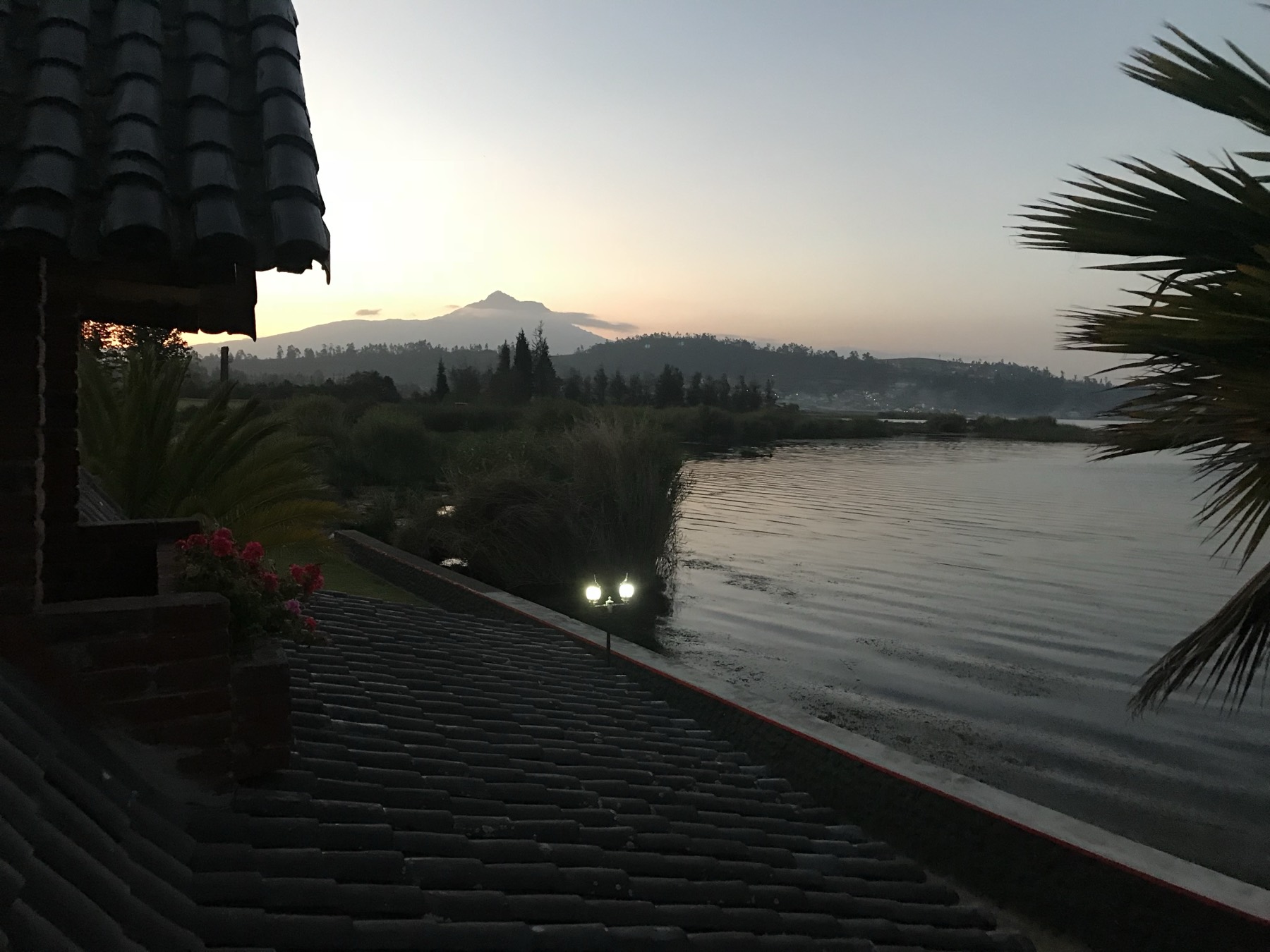
I woke to daybreak beside Lago San Pablo, facing Mount Imbabura, in San Rafael de la Laguna. But before the dawn there was a night, and what a night. I arrived seeking one single thing —to truly sleep— closed my eyes and, without meaning to, slipped into a kind of meditation. In it I saw an old man paddling a canoe through the reedy shallows of the lake; we had something like a spiritual duel. I’ve meditated since I was four, so these things don’t frighten me: I closed myself off, shielded myself, and slept like a walrus on the beach, like a sloth that has just moved into a deeper tree.

The next morning —by then that whisky was pure fermentation in my belly, not a gram of effect left— I ordered breakfast and worked up the nerve to step out of the room. It was a wooden suite at Puerto Lago, a country inn right at the water’s edge, with a balcony that opened onto Imbabura, onto a beautiful lake and a great many birds. (I confirmed it years later, matching that night’s photos against their geotags: I had slept at Puerto Lago, 5 km south of Otavalo, where —they say, and they don’t exaggerate— you can see “the majestic Imbabura volcano mirrored in the lake’s crystalline waters.”) It felt strange, I won’t deny it. But you know what? I felt like a kid who’d skipped class: like those wonderful outings you’d sneak off on against school rules, like the day you slip out of the office having said by email, straight-faced, so sorry, you’d woken up with the flu. And there I was, before the immensity of the Andes, the air clean and clear, plenty of sun and a still lake. That day I had a stroll, meditation, and a meal; I wrote a few emails to confirm my sessions; and, on the advice of the security chief, I set out the next day to carry on.

I didn’t know it then, but I had landed in a sacred place. Lago San Pablo —Imbakucha or Imbacocha in Kichwa— is the largest lake in Imbabura: some 583 hectares of water at 2,700 meters of altitude, glacial in origin, resting at the foot of the Imbabura volcano (4,630 m). For the peoples of Otavalo it is a sacred site, a wellspring of myths, rites, and legends —perhaps that’s why the old man in his canoe came to me. On its shore, San Rafael de la Laguna —a parish since June 7, 1884, with about 5,000 inhabitants— weaves the totora reed that grows in the lake and turns it into little reed boats, mats, and figures; it does so well that in 2024 UN Tourism named it one of the world’s Best Tourism Villages.

What came afterward —Otavalo and its market, the yachaks, the descent to the coast of Esmeraldas, and that final loop back south to cross into Ipiales to growl at a bank— is the stuff of the next chronicle.
For now this is enough: I left Bogotá by night, my soul a little broken, and woke to daybreak facing Imbabura, alive, breathing clean, clear air. Sometimes starting over looks far too much like being thrown out of your own home. And sometimes, with a bit of luck, it looks like arriving.
To be continued.