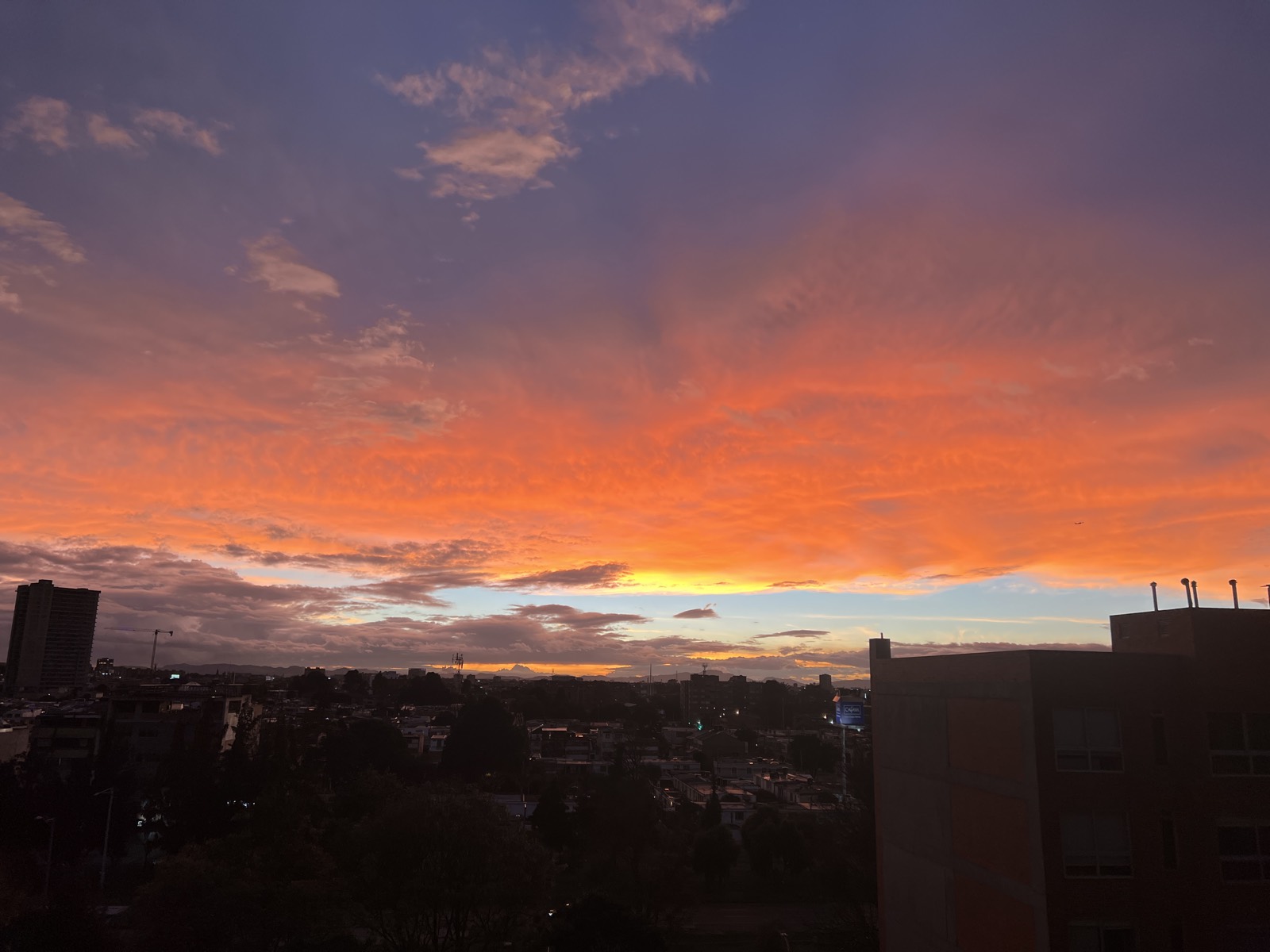
There are cities you arrive in and cities you set out from. Bogotá, for me, is one of the second kind: the fixed point, the nail the rest of the map hangs from. It sprawls across a cold green savanna, wedged up against the hills at 2,640 metres above sea level (Alcaldía Mayor de Bogotá; DANE), where the air thins a little and you feel, with no exaggeration, that much closer to the stars. Mornings break under a silver-grey sky that isn’t sadness so much as character, and by mid-afternoon the stubborn drizzle sets in — that fine, needling rain — and sends you hurrying for shelter in the nearest café. Monserrate and Guadalupe keep watch from above like two old sentinels. I have never known how to look at a place without asking what it feels, and Bogotá feels like a big house: cold at the door, warm once you’re inside.
My Bogotá: the room I was born in
Bogotá is the room of Our House where I was born. A city spread out across the altiplanicie cundiboyacense — the high plateau shared by Cundinamarca and Boyacá — perched on a tableland at 2,640 metres, a stone’s throw from something rare in the world: the páramos, the high Andean moorlands above the treeline. Up there grow some lovely furry plants, the frailejones — the tall, woolly rosettes of the páramo — which wring the water out of the clouds carried in on the ríos voladores, the “flying rivers” of moisture blown over from the Amazon, and then generously let it run, between the paws of the osos andinos de anteojos (the Andean spectacled bears), down the mountain and out to the savanna. I was born into a privileged home, but one that was always discreet, modest and socially minded.
And Bogotá, for me, is many Bogotás, each almost pinned to its own coordinates. There is the Bogotá of the far south — born of the demographic implosion that the conflict in the Colombian countryside set off: hard-working, all bare brick and, paradoxically, without a single sapling, as if adapting to the codes of the city meant renouncing nature at any cost; houses that grow upwards one storey at a time, an accent all its own, beautiful, generous people facing the security problems that marginalisation leaves behind. In my early childhood that was the zone the state had abandoned, where souls huddled together so the conflict wouldn’t gut them. There is the convulsive centre, with a Calle 19 that was all of Colombia at once, furious and endlessly interesting. There is Chapinero, whose buildings held a little of England, of France, of Italy, of art deco. And there is the North, where I spent almost my whole childhood: Batán, Malibú, La Alhambra — neighbourhoods settled on wetlands, beside the greyhound track and the underpass — spreading out as if to swallow don Pepe Sierra’s old hacienda and sweet Usaquén whole. I remember the day Unicentro opened: a great event for the city. And on the other side, Suba, which once you were over the hill turned into another kind of far south.
All of it framed by the embrace of the cordillera — that symbolic womb, as one writer put it, that holds Bogotá inside it. The cachaca Bogotá of the cafés, where men gathered to talk politics and economics but also literature and poetry, slowly became the home of every Colombian: haughty, prickly at times, but deeply cultured. Today it wakes up majestic, with something on every single day — theatre, concerts, exhibitions, lectures, festivals, dancing and more dancing — business, dealings with other nations… and trancón (gridlock), trancón and yet more trancón. In my last years there I chose the best option in the whole wide world: the bike. I’d turn up to meetings in a tie, at the reins of my little metal steed, threading between the saplings and waving goodbye to the poor motorists growling away inside the traffic. I remember it fondly, and on my last visit I found it dapper and cosmopolitan: a city that does a better job of integrating its people and is finally pulling away from that dreadful segregation by caste, by class, by estratos — the official socioeconomic tiers every Colombian is ranked into. More integrated. More of a home.
The people and their ways
The old-stock Bogotano is known as a rolo or a cachaco — a native of the capital — and carries a ceremonious courtesy that outsiders read as distance and I read as shyness. Here you call even your dearest friend and your own brother usted, the formal “you”; the familiar tú sounds almost cheeky. People greet you with an “a la orden” (at your service), offer help with a “¿le colaboro?” (can I give you a hand?), and everyone asks for things with an “hágame el favor” (would you do me the favour) that softens the enormous city. On Sundays the Ciclovía — the weekly closing of the main avenues to cars — clears the roads and sends millions out to pedal, jog and walk the dog: the capital’s great secular ritual. You climb Monserrate on foot or by funicular, you queue for oncecitas (the mid-afternoon snack), you get up before dawn for the rebusque — that national craft of improvising a living one day at a time — and at night the city turns into theatre: Bogotá has such a density of playhouses, universities and bookshops that it is, at heart, a student city. And above all it is a city made of everyone: the whole country washes up here — costeños, paisas, llaneros, pastusos, people who fled and people who came looking — and the capital keeps every one of them.
The flavours
The great dish is ajiaco santafereño, Bogotá’s chicken-and-potato soup: three kinds of potato that melt into the broth, corn on the cob, chicken, and the secret of the guascas — a native herb, gallant soldier — which tastes of nothing until, all at once, it tastes of everything, served with capers and a spoonful of cream. But the custom that really throws the newcomer is another one: a tamal for breakfast (steamed corn dough with meat, wrapped in leaves) alongside hot chocolate — and yes, you drop a piece of cheese into the chocolate, let it melt, and eat it with a spoon, without guilt or explanation. On cold mornings you order changua (a broth of milk, water, egg and coriander) or a caldo de costilla, a rib broth that could raise the dead. In the afternoon come the onces, that sweet snack of bread and herbal tea. And to celebrate, a heaped fritanga (a platter of fried meats and offal) and a canelazo — hot agua de panela, unrefined cane sugar dissolved in water, with cinnamon and a shot of aguardiente, the aniseed cane spirit — to chase the savanna chill away.
How they talk
The cachaco accent is unhurried, clear, a touch solemn; they say it’s the most “neutral” Spanish in Colombia, though no accent ever truly is. The formal usted rules everything — Bogotanos use it not just with strangers and elders but with close friends, siblings, even lovers, where other Colombians would slip into the familiar tú; here the formal form isn’t distance but a kind of tenderness. Sentences end on a “¿sí o qué?” that asks you to agree, apologies come as a “¡qué pena con usted!” (how embarrassing, do forgive me) that does equally well for a trodden-on foot and a large favour, and when something goes wrong it’s summed up in one dry, perfect word: “paila” (done for). A child is a chino or a china; someone you love is called, with a tenderness that comes down from the highlands of Boyacá and Cundinamarca, sumercé — from “su merced”, “your grace” — an old form of address that here doesn’t humble you but wraps you up. It is a city that asks permission before coming in, even when it speaks.
Hard facts
- Population: 7,918,660 inhabitants in 2024 — 15.1% of all Colombia (DANE, 2024 projections); the population is expected to peak around 2026, at close to 7,945,996 (DANE, 2024).
- Altitude: 2,640 metres above sea level (Alcaldía Mayor de Bogotá; DANE).
- Density: the urban area is among the densest in Latin America, at more than 20,000 inhabitants per km².
- Education: an illiteracy rate of 2.4% among people aged 15 and over, one of the lowest in the country (DANE, Census/statistical atlas).
- Health: insurance coverage is close to universal, with more than 95% of the population enrolled.
- Water and sanitation: mains-water coverage above 99% and sewerage at 98.5% in the urban area — among the highest in the country (EAAB-ESP).
- Connectivity: 85.9% of people aged 5 and over used the internet in 2023, one of the highest rates in Colombia (DANE, 2023).
- Economy: Bogotá generates around 25% of national GDP — one in every four pesos in the country is made here (DANE, departmental accounts 2024pr).
- Inequality: a Gini coefficient of 0.530 in 2023 (DANE, 2023); monetary poverty fell from 24.2% (2023) to 19.6% (2024) (DANE, 2024).
Postcards from the high house


You leave Bogotá wearing a coat, even when it’s warm outside, because you never quite believe you’ve left. It is the high house, the cold one, the house of drizzle and hot chocolate with cheese; the city that sees you off without any drama — “que le vaya bien, sumercé”, go well — and waits for you just the same, with the green savanna and the hills right where they were. The nomad has been walking for nine years, crossing seas and accents, and still the whole map hangs from this nail at 2,640 metres. Every other house in the world is one you arrive at; this one is the house you come back to. And coming back, here, always feels like shrugging the cold off your shoulders.