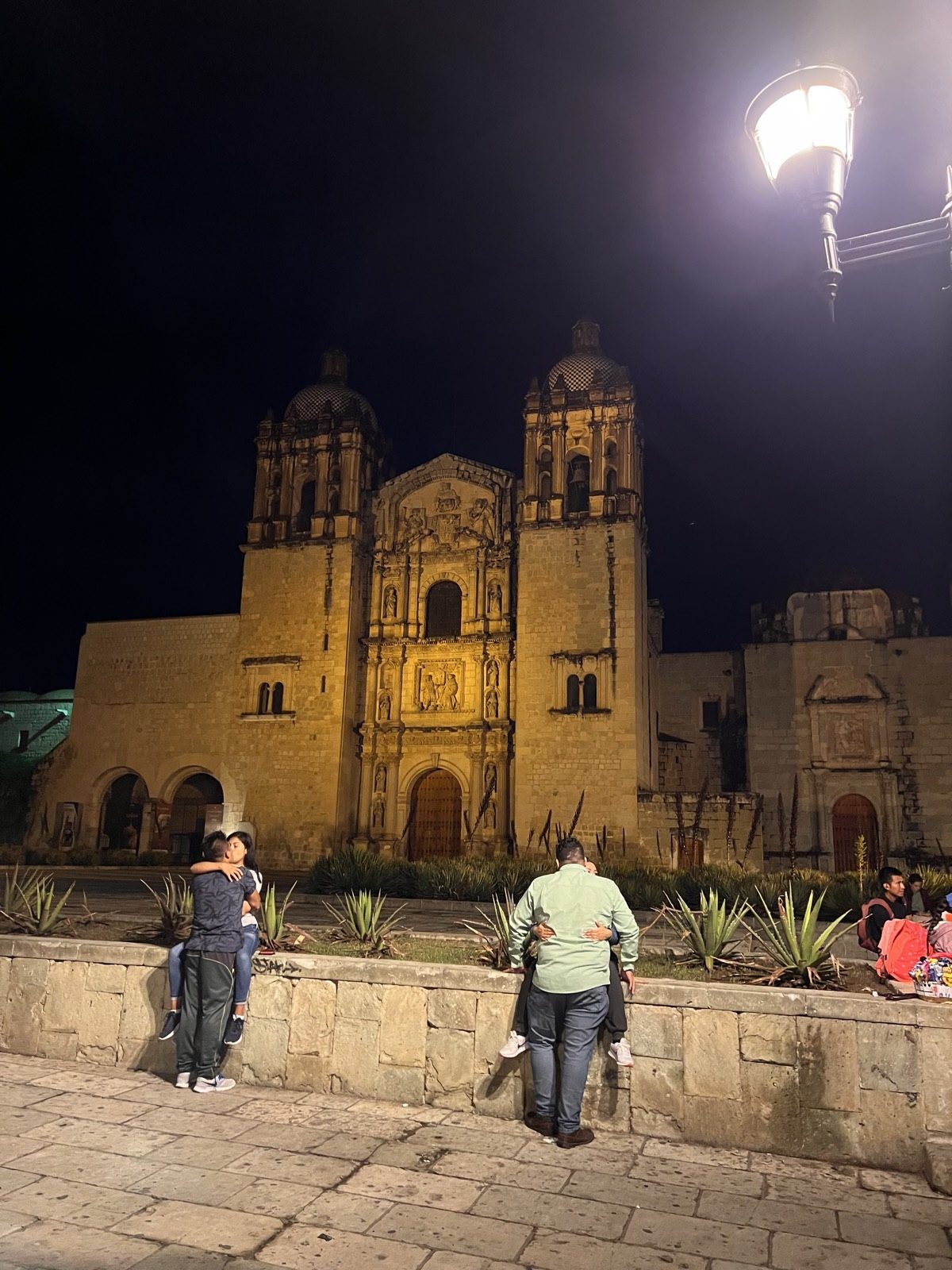
There are cities you visit and cities you live in from the inside, even when you’re only passing through. Oaxaca de Juárez is one of the second kind. It lies back in a broad, luminous valley, held in the arms of the Sierra Madre del Sur, about 1,555 meters above sea level (INEGI), where the sun comes down clean and thick, with none of the highland mist or the mugginess of the tropics. The light here doesn’t illuminate; it caresses. It sets the green cantera of the churches alight until, by late afternoon, it has turned to gold; it settles into bougainvillea-filled patios and makes the black clay and the red of the mole gleam on the griddles. It smells of copal, of toasted corn, of freshly poured mezcal. I have never known how to look at a place without asking what it feels, and Oaxaca feels like a house made of earth: solid, ancestral, warm from all the fire that has been cooked inside it. A house where the world, even now, seems to have a navel.
My Oaxaca
I came into Oaxaca at night, from Puebla, and stayed on the outskirts — out where they once meant to move the city’s administrative heart, a center that in the end never quite managed to beat so far from the real downtown. It was a house with a self-contained apartment built onto the side, and the first to welcome me were some gorgeous dogs who decided, at the speed of light, that I was family. My host, Rosario Villalobos, turned out to be one of those people you’re grateful to have crossed paths with: a political woman in the best sense of the word, devoted to serving her community. Her daughter, Charo Serrano, is an indomitable force — a feminist, and now the first Mexican woman paraclimber to hold a world ranking, on her way to her World Cups in Korea and Japan. Her son works with graphic-design collectives. That family told me Oaxaca from the inside, and on the first night Rosario and I drove up to see the Tule.
I would go back several times — first on my own and later to meet up with my friends Ruth, who is German, and José Javier, from Guatemala. That first visit fell in turbulent times, the kind when every day dawned with a demonstration. And yet what stayed with me was the beauty: bougainvillea spilling everywhere, flowers on every side, magnificent architecture, and a food scene that runs from the legendary ice creams of the market all the way to the finest restaurants in the country.
But what you really breathe in Oaxaca is a rebelliousness that is no pose. Not rebellion for its own sake, but the kind that gets woven in community: people trying out another way of being and of feeling, of producing responsibly, of trading by cooperating, of holding one another up and growing together. All of it is encoded in the Guelaguetza. That is why, for me, Oaxaca isn’t just a place: it’s a field of social experiment, a return to the roots that brings along the best of the contemporary world — art, design, architecture, industry and commerce woven together in a way that is aesthetic and beautiful, communal and mutually supportive, feminine and ancestral.
A little history
Long before the first Spanish stone was laid, this valley already had a heart. On the hill that stands guard over it, the Zapotecs raised Monte Albán more than two thousand years ago and kept it as their capital for over a millennium (INAH; UNESCO, 1987), until power slowly crumbled into smaller lordships. A little farther on, at Mitla, Zapotecs and Mixtecs carved stone fretwork that no mortar holds together, a place of priests and of the dead. I walk these ruins and can’t help thinking that a city, like a person, always carries what it was before it knew its own name: Oaxaca was built on a memory that was already taken.
The Spanish city was founded in that same valley in the sixteenth century: a town from around 1529 and, by decree of Charles V, a city under the name of Antequera in 1532 (INAH). It was laid out the way dreams of order were laid out in those days — a central square and streets set at right angles, a plan attributed to Alonso García Bravo — and over that grid the convents grew up. The grandest of them, Santo Domingo de Guzmán, was begun by the Dominicans around 1552 and took more than a century to build (INAH): its façade, cut from the region’s cantera verde, the local green volcanic stone, is the stone that turns to gold in the late afternoon and gives the city its background color.
Oaxaca is also the cradle of two Mexican presidents born on its soil. One is Benito Juárez, a Zapotec from Guelatao who rose from shepherd to lawyer and from there to the presidency, architect of the Reform Laws and a symbol of sovereignty in the face of the Empire — the “Benemérito de las Américas” (INEHRM). The other is Porfirio Díaz, another Oaxacan, whose long reign would later give people plenty to talk about. When Juárez died, in 1872, the city took his surname and became Oaxaca de Juárez (Government of Oaxaca). And this house of cantera has had to rebuild itself over and over after the earthquakes — from the seventeenth-century collapse that hurried the friars’ move to the great quake of September 2017 (INAH) — always getting back on its feet. Maybe that is why its history never feels like it’s behind museum glass: it is still being kneaded every day, like clay and corn dough.
Another way of doing things
There is a word people say in Oaxaca without any solemnity, the way you’d say bread: comunalidad, communality. It was coined here, sometime in the nineteen-seventies, by two Indigenous thinkers — Floriberto Díaz, a Mixe, and Jaime Martínez Luna, a Zapotec — to name from the inside something that already existed: life understood as a we. It has five simple, deep roots — the land, the assembly that decides by consensus, the office you serve without pay, the tequio or shared labor, and the fiesta — and almost everything else hangs from them. This is no armchair theory: of Oaxaca’s five hundred and seventy municipalities, four hundred and seventeen choose their authorities through their own normative systems — the so-called usos y costumbres, customary law — recognized by statute (IEEPCO). Here, across much of the state, you don’t vote for a party: you raise your hand in an assembly, and whoever is named shoulders the charge the way you’d accept an honor and a burden at once.
That habit of seeing yourselves as a we also knows how to get angry. Oaxaca has a long tradition of digging in its heels, and its most recent wound has a date: 2006, when a list of demands from the Section 22 teachers’ union and an eviction gone wrong set off an uprising that drew more than three hundred organizations together in the APPO. They were hard months, with pain on every side — the kind not to be recounted lightly, nor from a single camp — and out of those walls taken over by slogans was born, almost by accident, one of the liveliest graphic-art scenes in Latin America. It produced collectives like ASARO and Lapiztola — “lápiz” (pencil) plus “pistola” (pistol): the gun that fires color — who turned the stencil and the print into a way of speaking out loud, and in the street.
And presiding over it all, the generous shadow of Francisco Toledo, the Maestro: the Zapotec artist who founded the Institute of Graphic Arts (IAGO) and gave his city an open-stack library, who stopped a McDonald’s from opening on the main square by handing out tamales, and who defended native corn the way you’d defend a relative. You walk through Oaxaca and understand that here, resisting and making beauty are one and the same gesture: coffee and mezcal produced by cooperatives, tourism run by the Sierra’s own villages, weaving looked after as heritage. Another way of doing things: slower, more stubborn, more everyone’s.
Art and letters
If mezcal and mole come in through the mouth, painting comes in through the eyes and stays. Historians talk of an “Oaxacan school” — a way of painting in which color is very nearly a language — and its founding father is a son of this city: Rufino Tamayo (1899-1991), the universal Oaxacan, who took out into the world watermelons and human figures burning with the same earth-and-fire palette you see on the griddles. Tamayo gave Oaxaca back something more than fame: in 1974 he gave it the Museum of Pre-Hispanic Art of Mexico that bears his name — more than a thousand pieces he and his wife Olga gathered over decades to rescue the ancient art from oblivion, each room painted in a color of his own choosing (México Desconocido; rufinotamayo.org.mx). To that legacy add MACO, the Museum of Contemporary Art, opened in 1992 (El Universal). You go in to look at paintings and come out having looked, instead, at yourself from the inside.
The school has other names that deserve saying out loud. Rodolfo Morales (1925-2001), from Ocotlán, painted a magical realism of floating women and dreamed-up villages, and with what he earned he set up a foundation in 1992 to restore the churches and heritage of his valley — he painted and, at the same time, he repaired (Masterworks; Fundación Rodolfo Morales). Earlier, and more quietly, Francisco Gutiérrez (1906-1945) had brought the tremor of Cubism into Oaxacan printmaking (Wikipedia). And alongside Toledo, already mentioned, that lineage reaches all the way down to the anonymous hands that carve the alebrijes, those fantastical painted wooden creatures: impossible animals worked in copal wood — the sacred incense tree — in villages like San Martín Tilcajete and Arrazola, unknowing heirs of the tonas, the animal guardian spirits of the Zapotec worldview (FAHHO; Atlas Obscura). Here the folk and the learned don’t compete: they take each other by the hand.
And then there are the letters, which in Oaxaca come first from the voice. Andrés Henestrosa (1906-2008), a Zapotec boy from Juchitán who arrived in the capital without a word of Spanish, gathered the myths of his homeland in Los hombres que dispersó la danza (The Men the Dance Scattered, 1929): creation legends told as by someone who heard them beside the hearth (CVC, Instituto Cervantes). That calling as a reading people shows in the book fairs and, above all, in Toledo’s work as a builder of libraries: besides his open-stack library he championed the Jorge Luis Borges Library for the blind (1996) and the BS children’s library, so that those who cannot see and those who are only just starting could read too (El Universal). I leave thinking that in few places is art so little decorative: here it doesn’t hang on the wall to prettify things — it is spoken, carved and handed down the way a mother tongue is handed down.
And something has to be said about muralism, that great Mexican invention I love with devotion. After the Revolution, Mexico took art out of the museums and put it on the walls, out in the open air, for the whole people to see: Diego Rivera, José Clemente Orozco and David Alfaro Siqueiros — the big three — painted history, pain and hope on public walls. Oaxaca isn’t the cradle of those giants, but few places have inherited their impulse the way it has: here the wall is still a canvas. Murals unfold everywhere — hummingbirds over prickly pears, tehuanas with a steady gaze, ancient deities — living side by side with the combative prints of the collectives. In Oaxaca art isn’t hung on a wall: you walk through it.
The people and their ways
Oaxaca is, before it is a city, a mosaic of peoples: the state recognizes sixteen Indigenous peoples — among them the Zapotecs and Mixtecs, the most numerous — as well as the Afro-Mexican people (Government of Oaxaca), which makes it the most diverse corner of Mexico. And that root beats in everyday life. The tequio survives here — the unpaid communal labor by which an entire village raises a school or mends a road, because what belongs to everyone is looked after by everyone. The guelaguetza survives — a Zapotec word for the reciprocal gift, the “today for you so that tomorrow for me” — so alive that it lent its name to the great July festival, when delegations from the eight regions come down to the Cerro del Fortín to dance and hand out their produce to the crowd. The mayordomías survive, the festive offices a neighbor takes on out of honor and out of faith. And above all the Day of the Dead beats here, which in Oaxaca is not a costume but an open door: altars are raised with cempasúchil marigolds, bread and candles, and those who have gone are awaited with food and music, without fear. The Oaxacan is courteous, reserved, kind in a way that is never in a hurry; a stranger is met with a full plate before a question.
The flavors
Oaxaca is called, and nobody dares to argue, the gastronomic capital of Mexico, and you only have to sit down once at its table to understand why. It is the land of the seven moles — negro, rojo, coloradito, amarillo, verde, chichilo and manchamanteles, the “tablecloth-stainer”, a sweet red one (Secretaría de Cultura, 2020): seven different ways of grinding the world inside a clay pot. The king is mole negro — mole being that complex sauce of chiles, spices and, often, chocolate — dark as the dead of night, where burnt chile, chocolate and more than thirty ingredients make their peace in a sauce that tastes to me, above all, of patience: nobody cooks like this in a hurry. The daily bread is the tlayuda, a huge crisp griddled tortilla smeared with asiento (fragrant unrefined pork lard), beans and quesillo, the Oaxacan string cheese that unravels like a skein of wool, topped with tasajo (thin slices of salted beef) or pork cecina enchilada, grilled over charcoal.
None of this makes sense without the markets, which are the city’s true burning heart. In the Mercado 20 de Noviembre you come to the pasillo del humo, the “smoke corridor”, a row of braziers where you pick out your raw meat, watch it grill in thick clouds and sit down to eat it at long shared tables, elbow to elbow with strangers who stop being strangers at the first bite (Oaxaca.travel). Around the corner, the Mercado Benito Juárez overflows with chapulines — grasshoppers toasted with garlic, lime and salt, which crunch and taste of open country — and, above all, with nieves, artisanal sorbets churned by hand in wooden barrels: burnt milk, prickly pear, corn, walnut, sorbet. I confess a hopeless weakness for those nieves; there is something of a childhood recovered in a cup of burnt-milk ice under the midday sun.
For drinking, Oaxaca keeps treasures that date from long before the conquest. Tejate — from the Nahuatl for “floury water” — is the “drink of the gods”: nixtamalized corn, cacao, mamey pit and the rosita de cacao flower, ground on a metate until a pale foam rises to crown the gourd (Secretaría de Agricultura, gob.mx). There is water-based chocolate, thick and frothy, whisked with a molinillo and drunk in slow sips. And presiding over everything is mezcal, the agave spirit with its own denomination of origin since 1994 (COMERCAM), which here is drunk not to get drunk but to talk, slowly, “para todo mal y para todo bien” — for every ill and for every good. Oaxacan tamales come wrapped in banana leaf — not corn husk, as in the rest of the country — moist with yellow or black mole.
And then there is the other Oaxaca, the one that turned this age-old cooking into a world gastronomic destination. Out of its kitchens came a generation of chefs — Alejandro Ruiz at Casa Oaxaca, among many — who reinterpret native corn and mole with a contemporary eye; when the Michelin Guide came to Mexico for the first time, in 2024, Oaxaca picked up its first stars — Levadura de Olla and Los Danzantes — without ever giving up the clay pot (Michelin Guide, 2024). But what moves me most is neither the haute cuisine nor the market but what the two have in common: here, eating is never a solitary act. The brazier is shared, the nieve gets passed around, the mezcal goes from hand to hand. To eat in Oaxaca is an act of memory and of community: to sit at its table is to let yourself be adopted by a people who know, in their bodies, that food — like affection — only truly exists once it is given.
A river of bougainvillea
And you have to stop for the flowers, because in Oaxaca they are very nearly a branch of town planning. Bougainvillea pours over the cantera and whitewashed walls as if the city had decided to dress for a party every single day: blazing magenta, fuchsia, bishop’s purple, orange, blood red, white and even an impossible salmon — often all on the same plant — climbing a railing or tumbling off a rooftop. The sheer quantity of flowers, everywhere, is staggering. Strictly speaking, bougainvillea has almost no flower at all: the color lives in thin leaves, the brácteas or bracts, that cup a tiny white blossom. And that, perhaps, is the Oaxacan lesson in plant form: beauty here isn’t at the center but in what surrounds, in what keeps company. To the bougainvillea add the flame trees in full blaze, the jacarandas, the cempasúchiles that summon the dead, the pots on every balcony. You walk down cobbled lanes between terracotta walls and, all of a sudden, over the ochre, comes that cascade of color that asks nobody’s permission. It’s as if even the plants here understand communality: they bloom toward the street, for everyone, for whoever happens to be passing.


How they talk
Oaxacan Spanish is soft and sing-song, full of diminutives that sweeten everything: a “cafecito”, an “ahorita” that can mean in a little while or never, a “poquito” that is measure and tenderness in one. When someone hasn’t caught what you said, they don’t say “¿qué?” but a courteous “¿mande?” — literally “command me?”, a polite “pardon?” — the inheritance of centuries of ceremonious dealings. Many everyday words come from Nahuatl — tejate, tlayuda, chapulín, elote, molcajete — and others from Zapotec, like guelaguetza itself. And beneath the Spanish breathes an archipelago of living languages: Zapotec and Mixtec are spoken in the street, in the market, at the village fiestas, each with its variants and its tones, because here a single language changes its sound from one valley to the next. In Oaxaca, to speak is also to remember who you are and where you come from.
The valley around it
Although this chronicle belongs to the city, it would be unfair not to lean out toward the valley that embraces it, because Oaxaca de Juárez is also the gateway to a country of wonders just a step away. On a hill that commands the savanna stands Monte Albán, the ancient Zapotec capital carved into the rock more than two thousand years ago. To the east lies Mitla — from the Nahuatl Mictlán, “place of the dead” — with its stone-mosaic fretwork that no mortar holds together. Farther out, Hierve el Agua lets its petrified mineral waterfalls spill into pools where you bathe while looking out at the sierra. In Santa María del Tule breathes the Tree of Tule, a thousand-year-old ahuehuete with one of the widest trunks in the world. And in Teotitlán del Valle the Zapotec looms go on weaving rugs with cochineal and indigo, while Santiago Matatlán distills, village after village, the mezcal that perfumes the valley. Each of those places deserves its own story — and little by little each will get its own chronicle in this house; for now it’s enough to know that the city doesn’t end at its streets: it is the heart of a valley that breathes memory.
Hard facts
- Population: 258,913 inhabitants in the municipality of Oaxaca de Juárez (INEGI, Population and Housing Census 2020); the state of Oaxaca as a whole has 4,132,148 people (INEGI, 2020 Census).
- Altitude: around 1,555 meters above sea level, in the Valley of Oaxaca, at the foot of the Sierra Madre del Sur (INEGI).
- Indigenous languages: 31.2% of the state’s population aged 3 and over speaks an Indigenous language — more than a million people — the highest proportion in Mexico (INEGI, 2020 Census).
- Diversity of peoples: Oaxaca recognizes 16 Indigenous peoples, plus the Afro-Mexican people, making it the most culturally diverse state in the country (Government of Oaxaca).
- World Heritage: the Historic Center of Oaxaca and the Archaeological Site of Monte Albán were inscribed on the World Heritage List in 1987 (UNESCO).
- Poverty: 58.4% of the state’s population was living in poverty in 2022 — including 20.2% in extreme poverty — the third-highest figure in Mexico (CONEVAL, 2022).
Postcards from Oaxaca


You leave Oaxaca with your palate on fire and some part of your soul running slower, as if the city had deliberately turned down your revs. It is the house of clay and green cantera; the house of copal and corn, of the dead who come back and the living who share. A city that doesn’t rush because it knows something the others have forgotten: that time is looked after between everyone, like the water and the road. The nomad crosses seas and hurries, and yet here he learns all over again the oldest lesson of the house — that giving and receiving are one and the same gesture, and that there is always room at the table for one more. You don’t say goodbye to Oaxaca; you say “until I’m back”, with the warm certainty that the food will still be on the table.
